The Bible in the Critic’s Den 3By Earle Albert Rowell (1917)
THE SPIRIT OF HIGHER CRITICISM
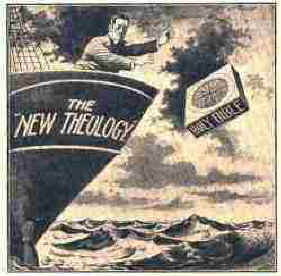
We would count a captain or pilot a fool or madman who would cast overboard his compass and steer by inward consciousness. How much more the folly or madness of the new theology which casts from the ship of Zion God's compass, the Bible?
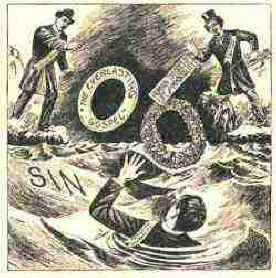
VI- NEW METHODS OF INTERPRETATION"If the foundations be destroyed, what can the righteous do?" Ps. 11: 3. ARE you seeking truth? Then look not to the men, but to the teaching. This is the Bible method, and the only effectual one. "To the law and to the testimony: if they speak not according to this word, it is because there is no light in them." Isa. 8:20. Adopting this principle, let us fearlessly apply it to the higher criticism. The interpretation of the Old Testament by New Testament writers is marked by their practice of seeing Christ in all parts of the Old Testament. But the interpretation of the Old Testament by higher critics is, on the contrary, marked by their practice of excluding Him from it entirely. Says the most recent, and, from the higher critical viewpoint, the most authoritative history of interpretation: "There is no evidence that Jesus saw a predictive element in the Old Testament; no evidence that, in His thought, any Old Testament author had foreseen His historical appearance, the circumstances of His ministry, His death and resurrection."- Dr. Gilbert, "History of Interpretation," page 71. What about Christ's quoting Isa. 61: 1, 2 in Luke 4: 17-21, and saying, "To-day hath this scripture been fulfilled in your ears"? And still further: "And beginning from Moses and from all the prophets, He interpreted to them in all the Scriptures the things concerning Himself." Luke 24: 27. And yet, there is "no evidence that, in His thought, any Old Testament author had foreseen His historical appearance"! In order to exalt their own authority and infallibility, they must first insist that Christ's methods of interpretation were not only faulty, but mistaken. "Of what in modern times is regarded as the technical qualification for scientific exegesis, He had, of course, no more than the generation in which He belonged."- Dr. Gilbert, "History of Interpretation," page 72. So Christ Himself is held up to ridicule because He does not doubt His own words, because He was not a higher critic, because, forsooth, He was not an infidel! Higher critics defend their position-by illustration. "Many people are alarmed, as if, when we begin to remove the dirt from an old master, we were going to destroy the glorious picture itself. But we remove the dirt which has become incrusted, that the picture may be more clearly seen and better appreciated than before." Joseph Wood, "The Bible," page 12. What should we think of the student of art who brought a microscope with him into an art gallery, and when he saw what looked like a flyspeck off in the corner of a picture, immediately turned his microscope upon it, and lost himself in examination of that flyspeck, and left the gallery without having even noticed the picture itself, but discoursed learnedly and wrote profound tomes upon the chemistry, etc., of the flyspeck in the corner? But one who is not willing to spend time in erudite investigation of supposed flyspecks, but prefers to devote it to the study of the majesties, splendors, and unrivaled beauties of the Bible, is laughed to scorn as ignorant, if not an imbecile. Their principles of interpretation lead the critics far astray. One of their primary principles, tacitly used or openly avowed, is this: Given a scripture which admits of two meanings, one making sense and the other nonsense, choose the latter as the only meaning admissible, criticize according to higher criticism, and eliminate from the Bible, as evidence of the ignorance of the writer, and proof that the Bible is "full of errors, imperfections, contradictions, prejudices, passions, . . . that it had its birth in the mind of man." Bampforth, "The Bible from the Standpoint of Higher Criticism," volume 2, page 263. Disagreements are confessedly assumed, and then the whole account is discredited because of this disagreement. This is one of the higher critical favorite methods of attack. Another principle of interpretation is one laid down by Dr. Briggs: "The argument from silence is of great importance in the higher criticism of Holy Scripture."- "Study of Holy Scripture," page 307. In this way, critics can prove almost anything. So they proceed to build, with all gravity, massive systems of theology, or lack of theology, upon things not in the Bible or any other book, only in their own imaginations. For instance, we are told: "From the silence of the periods of Samuel and the kings regarding the Priest's Code, it is reasoned that the provisions of this code were unknown at the time; hence they were not in existence; for they must have been known if they existed; hence the books commonly ascribed to Moses, the Pentateuch,- in which alone we have a record of the alleged origin of the Priest's Code,-were not in existence at the time of Samuel and kings."-Zenos, "Elements of Higher Criticism," page 88. But let us admit this loss for the present, and see if it proves anything. Says Sir James Stephen: "When the barbarism of the domestic government [under the Carlovingian dynasty] had thus succeeded the barbarism of the government of the state, one of the most remarkable results of that political change was the disappearance of the laws and institutions by which Charlemagne had endeavored to elevate and civilize his subjects. Before the close of the century in which he died, the whole body of his laws had fallen into utter disuse throughout the whole extent of his Gallic dominions. They who have studied the characters, laws, and chronicles of the later Carlovingian princes most diligently, are unanimous in declaring that they indicate either absolute ignorance or an entire forgetfulness of the legislation of Charlemagne."-"Lectures on the History of France," lecture 4, page 94. This case, taken together with the even more remarkable one of the utter loss and eradication from all secular records, for over four thousand years, of the extensive laws of Hammurabi, demonstrates that it is possible for not only the observance but all knowledge of a law to perish. Thus we see how futile is the argument from silence in this case, even granting the premises, - that the law was forgotten during the time; but there is no evidence that such was the case. On the contrary, there is abundant reference, in both the books of Samuel, to the law, or code. See I Sam. 2: 28, 29; 3:3; 4:3; 7:9; 8; etc. But the most remarkable use ever made of the argument from silence must be accredited to the Rev. Dr. Briggs: "A careful study of all the ethical passages of the Old Testament convinces me that there is an entire absence of censure of the sin of falsehood until after the exile; and then largely under the influence of Persian ethics."-"Study o f the Holy Scripture," pages 308, 309. No censure of falsehood until after the sixth century B. C., and even then borrowed from Persia! What does the discerning reader think of such a statement, in the teeth of "Thou shalt not bear false witness against thy neighbor," "Thou shalt not take up a false report," not to mention the multitudes of scathing rebukes poured forth in burning eloquence by the prophets prior to the exile? See Ex. 20:16; 23:1, 7; Deut. 5:20; 19:16-19; Judges 16:10; Ex. 18:21; et al. Dr. Briggs then pauses to admire the results and the method of his work: "These are examples of the methods by which the evidences of the higher criticism may be applied to Holy Scripture. They are constantly applied by scholars all over the world, in all the ranges of Biblical literature. If carefully applied, tested, and verified, they lead to sure results."-"Study of Holy Scripture," page 309. Says Dr. Briggs in another place, "Joel used to be regarded as the earliest of the prophets; he is now commonly considered one of the latest."-Id. This is how "sure" their results are, himself being the judge. Another principle of interpretation is this: If two writers record the same event in the same or practically the same language, as do Matthew and Mark, then they both borrowed their ideas from some common source, and are not to be relied upon, because we do not know how trustworthy that common source is. On the other hand, if two writers see the same event from different but equally true angles, as do James and Paul, then one or the other must be wrong, probably both, and the higher critic constructs a theory which alone can be right. If a certain event is recorded by only one writer, it is not to be credited, because it is unsupported by other testimony! And the moment it should receive such support, it would be ruled out of court on other grounds! But this is not all; for if a writer is silent concerning a certain event which the higher critics think he ought to have written about, of course he is then adjudged as ignorant of it, and held up to ridicule because of this ignorance, and branded as unreliable in everything else. Even Christ has been denounced by higher critics because He was silent concerning a hundred things they think He ought to have left teachings about. And because He did not, He has been called ignorant of them. This is no trivial matter for the Christian. It strikes at the very foundations of his faith; for if the higher critic's methods of interpretation are true, then every inspired writer is discredited, on one pretext or another, as ignorant, or denounced as maliciously deceiving, and faith in the Bible is absurd, and faith in Christ impossible, for the means for knowing Him have been destroyed. Seeing where these principles lead us, we need no other proof that they are not only false, but the baseless figment of a chimerical imagination. And we are led back to the consideration of the fact that the only safe, the only true method of interpretation is that employed by our divine Lord and Master: "Beginning from Moses and from all the prophets, He interpreted to them in all the Scriptures the things concerning Himself." Luke 24:27. Human theories of salvation are no more efficacious to save than a wreath of water-saturated flowers. "The Everlasting Gospel" is God's life-buoy to the soul struggling in the billows of sin.
VII- THE MATTER OF STYLE"AS analysis has been carried gradually further, it has become increasingly evident that the critical question is far more difficult and involved than was at first supposed, and the solutions which seemed to have been secured have been in whole or in part brought into question again."-Kuenen, "Hexateuch," page 139. In their desperate effort to make their theories stand the "acid test" of common sense, the critics are driven into difficult positions; and in their attempts to escape from a dilemma, they often flounder into worse embarrassment, or sink into quicksands of absurdity. The whole theory is one huge absurdity; but strangest of all is the fact that the very theories upon which they most pride themselves, and upon which they lay the most stress, are the ones most open to exposure, and most clearly the product of baseless imagination. Let one of their experts tell us the foundation principles of higher criticism: "Any one familiar with literature knows how difficult it is for a well-known writer to disguise his hand. It will often be recognized through all guises, even by those who are not expert."-Dr. Briggs, "Study of Holy Scripture," page 99. It is upon stylistic differences in the various parts of a Bible book that higher criticism is based. The whole top-heavy theory is built upon the supposed detection of different writers by a variation in style. Says Dr. Briggs, "Difference of style implies difference of author and period of composition."-Id., page 97. Since "higher criticism is a science, and its results as sure as those of any other science" (Id., page 105), let us push our inquiry a little further, and ascertain some of the scientific results of this new science when applied to the phenomena of style. Dr. Briggs says: "It is agreed among critics that the Ephraimitic writer is brief, terse, and archaic in style; the Judaic writer is poetic and descriptive. The Priestly writer is annalistic and diffuse, fond of names and dates. He aims at precision and compactness. The logical faculty prevails. There is little coloring. The Deuteronomic writer is rhetorical and hortatory, practical and earnest. His aim is instruction and guidance."- Id., page 301. Without inquiring too closely how he came into possession of all this information, we are now equipped with the means for tearing assunder the books of Moses, and apportioning to each of the above mentioned four writers his individual production. But hold! "It seems to be evident that there were groups of earlier Ephraimitic and Judaic writers, and these were followed by groups of Deuteronomic and Priestly writers, and the composition of the Old Testament was a much more elaborate affair than the earlier critics supposed."- Id., page 290. So instead of four writers, we now have hundreds! But many of them write so much alike that they cannot be distinguished! We are now gravely advised of this, in spite of the fact that we before were just as seriously informed that the whole theory rests upon the "scientific" ability of the critics infallibly to distinguish all the different writers, no matter how numerous, by their differences of style - which differences, we were told, could be detected by a nonexpert, they were so obvious! But let us see how obvious the differences are. Says Bishop Colenso - I prefer to let the critics refute each other: "The style of the two writers [E and J] is so very similar, except for the use of the divine names, that it is impossible to distinguish them by considerations of style alone."-"Pentateuch," volume 5, page 59. Even Dr. Driver admits the difficulty; but he is so wedded to the theory, that he is driven to the following logic in its defense: "Indeed, stylistic criteria alone would not generally suffice to distinguish J and E; though when the distinction has been effected by other means, slight differences of style appear to disclose themselves."-"Introduction," page 126. When learned men are driven to such absurdities of logic to defend a hypothesis, it is self-evident that they have an absurd hypothesis to defend. Take Deuteronomy. The first four chapters are declared by most recent critics to be the work of a different writer from the rest, though "the usage of speech is the same as in chapter 5-11" Otelli, "Commentary on Deuteronomy," page 9. This unwelcome difficulty is easily overcome by the naïve ingenuity of another higher critic: "The great similarity of language must be explained as the result of imitation."- Kuenen, "Hexateuch," page 117. How beautifully simple! It is no wonder that occasionally a higher critic becomes so ashamed of such childish methods that he admits their absurdity. The wonder is that more do not. Their theory is so pulverized by its own weight that Addis has to admit, after years of study on this very subject, that "attempts have been made to separate the component documents. . . . But the task seems to be hopeless, and there is nothing like agreement in result."-"Hexateuch," volume 1, page 165. This in spite of the dictum of Dr. Briggs, that it is so easy to detect differences in style that these differences cannot be disguised from the novice. Higher critics rest their whole case upon their ability to dissect the Bible records according to individuality of style. So sure was Canon Cheyne of his ability to do this, that he actually published a Bible in colors, "The Polychrome," or rainbow Bible, in which each color represented a different author. Often a single verse was so variously colored that it looked more like the gorgeous hues of an Indian blanket or a Turkish rug than a serious finding, of "the assured results of scientific scholarship." Since the leading higher critics of the world openly proclaim that their "assured results" are based upon detected differences in style, the subject is deserving of more serious consideration than is generally given it. In reading the productions of a higher critic, one is often led to wonder how he knows that a certain section or verse, and in some instances a lonely word, was inserted four or five hundred years later in such and such a country. We are told that they have such a marvelously acute literary sensitiveness that it detects, almost automatically, any variation of authorship. That no two thus endowed agree in results does not matter - the theory is correct anyway! Says Professor Zenos: "Critics are accustomed to speak of `critical divination' in a way to confuse the inexperienced layman. The phrase is an apt one, and may be used as a very convenient designation of a power which the successful critic has or must have."-"Elements of Higher Criticism," page 116. Two Selections of Different Styles from the Same Author
"Biglow Papers."
"The Present Crisis." With their verbal contortions and metaphysical jugglery, they have almost deceived the public into believing that negation is scholarship, doubt is liberal thinking, and assertion is proof. But if it is so easy to apportion to the proper period and person fused documents two and three thousand years old, how is it that the same infallibly delicate literary sensitiveness does not avail to discover the true author of the comparatively recent and world-famous "Letters of Junius"? The honor has been given to no fewer than fifty-six men, by various advocates. Why not apply some of this "critical divination" to Shakespeare's plays, and determine for us just what he wrote, or whether he wrote at all? And why have these gifted gentlemen not separated the individual work of Beaumont and Fletcher? How is it, with such an infallible, literary weather vane among us, that for two hundred years Lord Bacon was regarded as the author of a work of which he never wrote a word? Bryant was not only a poet but a newspaper man. Yet what a "difference of style" there was between his poetry and his editorials! Clarence Stedman was both a poet and a Wall Street banker. But who would expect to find his commercial letters identical in style with his poetry? Who that has read Madame d'Arblay does not know that she has not only two styles but even four? And who that has read Henry James is unfamiliar with the vast difference between the style of his first books and his present productions? Says Prof. John Earle: "The difference of manner in different parts of Johnson's writings is notorious; and it is satisfactorily explained by differences either in the circumstances of the writer, or in the occasion or subject of his composition."-"English Prose," Page 468. A student of Thucydides sees that he makes an unmistakable difference between the style of the narrative portions of his history, and the speeches which he puts into the mouths of his characters. "And so great is this difference, that it is necessary to treat the two separately, one might almost say, on different principles. . . . If the speeches were to be collected into one volume under the title of `The Orations of Thucydides,' and the history were to be put by itself, the characteristic differences might have led the critics to ascribe the two writings to different authors."- Zenos, "Elements of Higher Criticism," page 59. It is only by being untrue to their own principles that they do not declare that the orations and the history are by different writers; for "difference of style implies difference of author and period of composition," as Dr. Briggs informs us. By no less a writer than Herbert Spencer, in his famous essay on the "Philosophy of Style," there are laid down principles and facts which utterly demolish the higher critical analysis of the Bible: "One in whom the powers of expression fully respond to the state of feeling, would unconsciously use that variety in the mode of presenting his thoughts, which art demands. This constant employment of one species of phraseology, which all have now to strive against, implies an undeveloped faculty of language. . . . Let the powers of speech be fully developed, however- let the ability of the intellect to utter the emotions be complete - and this fixity will disappear. The perfect writer will express himself as Junius when in a Junius frame of mind; when he feels as Lamb felt, will use a like familiar speech; and will fall into the ruggedness of Carlyle when in a Carlylean mood. Now he will be rhythmical and now irregular; here his language will be plain and there ornate; sometimes his sentences will be balanced and at other times unsymmetrical; for a while there will be considerable sameness, and then again great variety. His mode of expression naturally responding to his state of feeling, there will flow from his pen a composition changing to the same degree that the aspects of his subject change." A consideration of these facts will surely lead us, with Professor Gwatkin, to protest against "the special pleading of a mechanical criticism, which ignores human nature in its chase after literary possibilities, and can only make out a plausible case by first assuming unlimited falsification and then correcting it with unlimited guesswork."-"Knowledge of God," volume 2, page 21. Similar absurdities are everywhere prevalent in the new theology writings on the New Testament. I have space for but one example. P. W. Schmiedel, professor of New Testament exegesis in the University of Zurich, in his article on Acts in the "Encyclopedia Biblica," begins by telling us that Acts contains "a whole series of demonstrable inaccuracies." Then we are informed that "no statement merits immediate acceptance on the mere ground of its presence in the book. . . Positive proofs of the trustworthiness of Acts must be tested with the greatest caution." In other words, it must be regarded as a liar until proved true. With surprise we read that "with regard to the speeches, it is beyond doubt that the author constructed them in each case are to his own conception of the situation." These speeches, then, are pure imagination, absolute fiction! Thus in one sweep of the pen, the learned Bible professor throws into the wastebasket the eloquent discourses of Paul, and the earnest orations of Peter. In consternation we may wonder what is left in Acts of value. He tells us: "In short, almost the only element that is historically important is the Christology of the speeches of Peter." And we have just learned that these speeches are pure fiction! This is monstrous enough; but further on, we reach a still more startling statement: "The value of Acts as a devout and edifying work cannot be impaired by criticism. Indeed, the book is helped by criticism, which leads beyond a mere blind faith in its contents." To such lengths as this a person is always led when he casts aside the "Word of truth," and is "blown about by every wind of doctrine." In the place of "sound doctrine," we have here an air of knowledge, a cant of advanced thought, and a sound of wisdom. The reader may be puzzled to determine upon just what grounds the higher critics base all these unproved theories and absurd and contradictory conclusions. Dr. Driver, one of the foremost higher critics of England, and considered "conservative," tells us frankly all about it "We can only argue upon grounds of probability, derived from our views of the progress of the art of writing, or of literary composition, or of the rise and growth of the prophetic tone and feeling in ancient Israel, or of the period in which traditions contained in the narrative might have taken shape, or of the probability that they would have been written down before the impetus given to culture by the monarchy had taken effect, and similar considerations, for estimating most of which, though plausible arguments on one side or the other may be advanced, a standard on which we can confidently rely scarcely admits of being fixed."-"Old Testament Literature," sixth edition, page 123. This is what the "assured results" of "scientific criticism" amount to. Here is the whole thing summed up in one comprehensive sentence by one of the world's leading higher critics; and upon his own showing, we see how utterly absurd, how absolutely flimsy, are their theories, how baseless their conclusions. This is the boasted higher criticism, which proves the Bible to be a tissue of pious lies. It utters infidelic nonsense as old as Celsus, with the gravity of a philosopher announcing the birth of a new and solemn truth. This is the way scholarship of the world is blackening the Bible, and then scorning it because it looks black to them. Are these "grounds of probability," "plausible arguments," which "may" be founded upon "our views"- are such inane puerilities to be accepted in preference to the authority of Christ, one of whose words should "not be broken," and who, has "the bread of life"? Shall we discard our confidence in the divine Book upon such baseless theories and pitiable logic? Shall we not the rather stand unmovable upon the eternal, fact that "Thy word is true from the beginning"? Ps. 119:160. The most momentous conflict between right and wrong of all the ages is just upon us; and only those who stand with both feet firmly planted upon the Word that "cannot be broken" will endure when the coming storm bursts in all its threatened fury.
|