The Bible in the Critic’s Den 5By Earle Albert Rowell (1917)
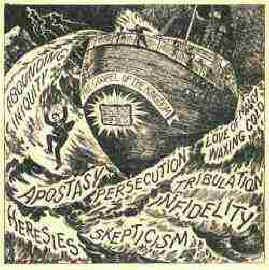
God's gospel ship has ever sailed through the troubled waters of sin, unbelief, apostasy, and persecution; and bearing that gospel, she will enter the eternal harbor.XI- MANUFACTURING A NEW GOSPELWE read that "all the Athenians and the strangers sojourning there spent their time in nothing else, but either to tell or to hear some new thing." Acts 17:21. As we have seen, this is the attitude of the higher critics. Any theory, any gospel, so long as it is new! Having discarded the ancient gospel of Christ, which "is the power of God unto salvation to every one that believeth" (Rom. 1: I6), and having taught doubt as essential to their gospel, they proceed to patch up a new gospel - an up-to-date gospel. Those critics who place the authority of Jesus very high, immediately place their own higher. The teachings of Christ are not often directly controverted, but they are often ignored, or treated as counsel of perfection which we are to admire rather than to obey. Listen to Harnack and Herrmann "It is obvious that in this workaday world, such principles are impracticable; no business can be conducted on these lines. Yet that is just what Jesus seems to want." "Had He meant these words to be universal rules, He would have been worse than the rabbis whose teaching He opposed." "The character of Jesus is made up of compassion and modesty, love and asceticism; and consequently He is no leader for men who with the means given them in this world wish to attain some definite object." "With regard to the utterances of Jesus, we confess that we cannot simply comply with them, since we do not share His conception of the universe, and so are living in a different world. On the other hand, the mind which they reveal should be present also in us; that is, the will to act in accordance with our own convictions."- "The Social Gospel," pages 1,59, 204, 212, 207. This, then, is the new gospel. Do not follow Jesus. No matter how clearly stated is the will of Christ, "our own convictions" are to be followed in preference, especially when from them has been eliminated compassion, modesty, love, and asceticism. Yes, dear reader, such are the teachings of the new theology. Their words are before you. I would fain believe that they are the sad words read in a bitter dream; but unfortunately they are only too real. I believe that these men are better than their teachings; but the better the personal life, the more vicious and extensive is the devastating influence of such teaching. If some drunken roué advocated the impossibility of following Jesus, of being modest, loving, compassionate, and self-controlled, those only would heed him who were more debauched than he. But when backed by the irreproachable private life, and stated with all the profound learning and charming genius, of Harnack and Herrmann, these restated teachings of the debauchee are enthusiastically applauded and blindly accepted. That such teachings are neither isolated nor overstated, is evident from the bold avowals of Dr. Campbell, England's premier exponent of the new theology, who tells us roundly that "sin is the expansion of the individuality."-R. J. Campbell, "New Theology," page 157. For fear that we may charitably mistake him, Mr. Campbell carries his principle to its hideous conclusion, with the blind disregard for results so often observed in higher critics: "However startling it may seem," he says, "sin itself is a quest for God. That drunken debauch was a quest for life, a quest for God. Men in their sinful follies to-day, and their blank atheism, and their foul blasphemies, their trampling upon things that are beautiful and good, are engaged in this dim, blundering quest for God. . . . The roué you saw in Piccadilly last night, who went out to corrupt innocence and to wallow in filthiness of the flesh, was engaged in his blundering quest for God."-Id., pages 150, 151. It needs no argument to prove that if these new teachings were believed by foreign missionaries, their work would become paralyzed, and foreign missionary work would not only languish, but would go rapidly from apathy to stupor, and from stupor to profound coma, from which only the impending second advent of Christ could arouse it. Is it any wonder that Christ, in looking down the stream of time to the present, said sadly, "Nevertheless when the Son of man cometh, shall He find faith on the earth?" Luke 18:8. In taking stock of how much of the gospel of Jesus higher criticism has left us, and seeing how scant it is, and how warped and corrupted even that little is, many unsettled souls are crying out, with Mary, "They have taken away my Lord, and I know not where they have laid Him." John 20:13. The terrible harvest of this higher criticism is already seen in the unsettled beliefs, the destroyed faith, the multiplied infidels, even in the churches, the weakened and empty churches, and the consequent increase of crime and vice. Aliens from God, outcasts from society, broken-hearted millions curse their miserable existence, and long for death as a desired release. From Africa's burning sands, from Russia's frigid steppes, from India's arid plains, from China's crowded lands, from the rocky cliffs of countless islands - from every land, in every clime - the cry of human woe is ascending in increasing volume, from the destitute, the afflicted, the diseased, and the dying. To these misery-laden souls, higher criticism can give only a gospel of scientific doubt, a Bible of shreds and patches, a book of myths and legends - a Christless Bible. Nothing but husks have the new theologians to offer the sin-burdened, empty-souled, world-weary child of the world. Since the story of the curse is held to be only a voice from the realm of fable, redemption must necessarily be the decadent fruitage of a hydra-headed myth; and a fabulous redemption from a fabulous curse is effected only by a nebulous, mystical, and mythical Christ, the fabulous product of unscrupulous deceivers, imposed upon an ignorant and superstitious people in an age of darkness. This theory is so prevalent among higher critics, and is taught so assiduously, that among the laymen, theories of Christ are rife, conclusions diverse, and faith wavering. The open or secret cry is, "We will not have this Man to reign over us." In this crude and mongrel system of Christianity, this incoherent conglomerate of antiscriptural religion, false philosophy, and infidel science, all the lifeblood of Christianity has been drawn from Christ's gospel, all the spirituality has been evaporated from His life, all the meaning from His words, and nothing is left us but muddy waters from the broken cisterns of ancient infidelity and modern "Christian" skepticism.
XII- EVAPORATING THE SUPERNATURALWE are firmly convinced that . . . there can be no such things as miracles."- Adolf Harnack, "What Is Christianity?" page 28. "As soon as the drama of Calvary is thus [by higher criticism] reduced to its true proportions, it becomes what it really was, a human historic drama. "-Sabatier, "The Atonement," page 130. "Such a phenomenon [resurrection, etc.] is in itself so improbable that any alternative is preferable to its assertion." -Professor Lake, "Historical Evidence for the Resurrection," page 267. "The questioning spirit of to-day," says Van Dyke, "everywhere asks for a reason, in the shape of a positive and scientific demonstration. When one is given, it asks for another; and when another is given, it asks for the reason of the reason. The laws of evidence, the principles of judgment, the evidence of history, the testimony of consciousness - all are called in question."-"Gospel for an Age of Doubt," page 8. By the broad and liberal man is always meant the man who minimizes or flatly denounces the miracles and all things supernatural. He disbelieves all evidence, however well attested, that contravenes his own article of faith that "miracles do not happen." The higher critic, equally with the agnostic and the infidel, is bound by his theory to reject as impossible all accounts of miracles, and endeavor to explain the recorded phenomena as either delusions of a disordered mind, or the deliberate invention of a malicious deceiver. No matter how much in the way of wonders may be admitted outside of the Bible, "any alternative is preferable to" acknowledging the authenticity of the Bible miracles. The seriousness of this widespread denial of the miraculous by the church, is recognized by a writer of high standing in the theological and learned world. Dr. G. A. Gordon sums up the general situation, the problem, and his own position: "The significance of the new question concerning miracles is that it comes from professedly religious men, and from men living and potent with the Christian church. It is a new discussion we face when the disciples of Jesus Christ in this twentieth century ask, Is miracle essential to religion? Is the essential truth of Christianity dependent upon the reality of the miracles embedded in the evangelical history? Is the message of Jesus Christ to man separable from the record of signs and wonders with which it is accompanied? Scientific men, in so far as they are under the scientific spirit, see no miracles. That is, they see no violations of the order of cause and effect; they expect no violations of their order; they believe in none. For them, the miracles of all religions are the interesting products of the human imagination; they are a chapter in the serious fiction of the world. May a member of the Christian church, may a preacher of the Christian gospel, in any degree sympathize with the attitude of science towards miracle, and yet remain loyal to his great Master? These are questions working in the religious mind wherever that mind has obtained a modern education."-"Religion and Miracle" (1909), pages 12, 13. Thus from the old home of American orthodoxy, New England, comes a book with all the attestations of Bostonian culture, written by one of America's best known divines, and its sole purpose is to eliminate all miracles from Christianity, in order that it may be more acceptable to the scientist and skeptic. He continues: "I am concerned to show that where miracle has ceased to be regarded as true, Christianity remains in its essence entire; that the fortune of religion is not to be identified with the fortune of miracle; that the message of Jesus Christ to the world is independent of miracle.... I conceive myself to be a genuine conservative; I am conscious that I work for the preservation of essential historic Christianity; I consider myself to be, to the extent of my power, a defender of the eternal gospel."-Id., page 10. Reader, consider well the above statement. Has it no significance for you? Dr. Gordon is a "conservative," he says. Yet he discards all the miracles of the Bible with a sweep of the hand, and along with them, the supreme miracle of the Bible, the resurrection of Jesus. (Id., page 107.) How radical such a position would have been in a preacher a century ago! But it is the position of "a genuine conservative" now! How much of the Bible or Christianity would a radical leave? More than that, he proclaims himself a defender of Christianity, of the eternal gospel, to the extent of his power. As already stated, this is the attitude taken by higher critics the world over. They are casting overboard their chart and compass, so that they may steer the ship better! The soldier is throwing away his sword, that he may the better defend himself with his bare arms! The drowning man spurns the lifeline, because it would encumber him in his efforts to save his life! This is the conservative method of defending Christianity! I come along a deserted street at night, and spy my bosom friend in a life-and-death struggle with an assailant. I hasten valiantly to his defense, and nobly pound him over the head, and aid his enemy, to show my friend how hard I am "defending" him! Thus do higher critics "defend" Christianity and its Source. And they are desperately in earnest, too. That they are inconsistent has nothing to do with their position, except that they make up in vigor of attack what they lack in justification for the attack. Is miracle, then, rejected without evidence? Listen: "Miracle is not part of my working philosophy of life, . . . because I cannot be sure of its reality, and I wish to live as far as possible among things that are sure."-Id., page 167. A "philosophy of life" having been adopted which excludes miracles, no amount of evidence could be allowed to disturb this precious little theory. But if being "sure" is the guiding principle of life, methinks that resting his faith upon the changing quicksands of higher critical theories is like seeking peace and quietude in a raging tempest. But how do the higher critics become so "sure"? "In their hands, the fate of the miraculous is a foregone conclusion. The miraculous goes as the landslide goes. It falls as the avalanche falls. In the order of nature, it could not be otherwise.. . . Judgment is set, and the miraculous is ruled out of court. The question is not discussed; it is assumed as settled."-Id., page 24. Now we see how easy it is to live among things that are so comfortably "sure"! Just deny the existence of anything you are not "sure" of, without troubling yourself to investigate it! "Assume" it to be nonexistent! When you have done this, you have become a scientist and higher critic, and entered the charmed and charming circle of the learned and the wise! Consistently with this "philosophy of life," an axiom has been invented for the guidance of higher critical investigation. "It has cone to be an axiom of historical criticism, that the presence of a miraculous element in any story or record . . . casts suspicion upon it."-Sunderland, "The Bible," page 132. Comment would be superfluous. The nature which the higher critics so ardently worship is unstrung and mistuned by man's agency in it. The nature that now is, the Bible and reflection both show, is an incomplete witness to God. How, then, may we judge the whole from the part, and that part diseased? How do we know that the laws we see are all the laws for God's universe? By what process of logic can a scientist deduce from a known law, the conclusion that God cannot have other laws operating? What man knows enough to deduce from a few observed phenomena on this earth, which is less than a trillionth part of the universe, laws which shall limit the Creator of the universe? St. Augustine was wiser than many moderns who boast their attainments. He gave utterance to a wise saying concerning miracles, that present-day thinkers would do well to consider: "We say that all miracles are contrary to nature; but they are not. For how shall that be contrary to nature which takes place by the will of God, seeing that the will of the great Creator is the true nature of everything created? So miracle is not contrary to nature, but only to what we know of nature."-De Civitate Dei, 21, 8, quoted by Sanday, "Life of Christ in Modern Research," page 216. It should seem by this time that scientists, and higher critics who ape their methods, would be a little more modest in their assertions of finality in their theories. Newton honored himself as well as God when he said he had but gathered a few pebbles on the great shore of truth. Edison likewise, after many fruitful years of study, said that if scientific discoveries should proceed at the present rate of progress for a few thousand years, humanity might then begin to draw a few conclusions. This is good logic and good Scripture. While God is expressed, He cannot be measured, by His works; least of all, by nature in its present state. We can apprehend but cannot comprehend God. The higher critics' arguments against the miracles sound learned and cogent when presented with the trimmings of genius, or in the sesquipedalian nomenclature so often affected by writers who desire to make a little thought go a long ways. But when reduced to their lowest terms, the arguments are self-destructive. In scores of books on this subject, the corner-stone argument supporting their structure of doubt proceeds on this wise: Some accounts of miracles in the Middle Ages and at other times have been proved to be false. The Gospel accounts of Jesus contain certain records of miracles. Therefore these miracles are false, and all miracles are false. One would be just as logical to argue thus: Some books have been proved to be trash. Isaiah and John are some books. Therefore Isaiah and John are trash, and all books are trash. To argue that all miracles are false because one is, is on a par with the argument that because one greenback is a counterfeit, all are. Yet on the strength of such principles of reasoning, we are asked to reject the word of the eternal God, whose "word is truth," and trust for guidance and salvation to the self-destructive absurdities of the new theology, or the pseudo science of evolution, or the infidelic effusions of Hume, Strauss, and Voltaire. Shutting their eyes to the lack of reason and evidence for the support of their shifting theories, they are not slow to denounce as hypocrites those who still accept the Bible as the revealed will of God. That I have not exaggerated, note the following: "How many preachers really believe the supernatural story from Adam to Christ, although they declare it to be one consistent whole? How many trained or scholarly teachers of youth themselves believe what they tell their pupils about Noah, and Abraham, and Jacob, and Moses, and Joshua, and Samuel, and David? How many really hold to the virgin birth while they solemnly recount it? . . An acted part at the altar, insincerity at the teacher's desk, drag down the moral standard of our national life."-Picton, "Man and the Bible," page 266. Here we see that the higher critic is so bent on forcing everybody to agree with him in discrediting the Bible, and aid him in his work of destroying faith in it, that he not only doubts the sincerity of those who do not believe as he does, but even boldly - one could hardly say, politely or generously -calls those hypocrites and dishonest who venture to have a different opinion. The first commandment in the higher critical decalogue is, Thou shalt have no other opinion before mine. Yet this is the "broadmindedness" of "liberal theology." Liberal, forsooth, when any minister who declares his belief in the sacred Word is called a liar and a hypocrite, and the degradation of the nation is laid at his door because of his expressing confidence in the Bible! Is it a small thing that men are called liars, and hypocrites, and "brainless idiots," for avowing a belief in the grand truths which our Saviour Himself believed with all His heart, and died the death of the cross to establish eternally? Right here I take issue with those who boast disbelief in the supernatural as any evidence of a "liberal mind" or a "free thinker." Since, as Gilbert Chesterton says, "a miracle is the liberty of God," those who discard the supernatural not only bind God, but fetter themselves to a certain contracted creed; for they are not free to believe miracles, no matter how great the evidence for them. So, instead of disbelief in miracles being an evidence of liberty of mind and freedom of thought, as the higher critics so loudly proclaim, it is just the reverse; for the man whose mind is ruled by a theoretical pronouncement which he must teach in the teeth of all contrary evidence, cannot possibly be as "free" as the man who has left his mind open to be impressed and convinced by the weight of any and all evidence. As well might one adduce a disbelief in the existence of the X ray, as proof of his breadth of thought and greatness of mind. The man who denies the supernatural, is neither liberal nor logical. The moment a man admits the existence of an omnipotent power, while denying the possibility of a miracle, he has contradicted himself; for if he binds omnipotent power, it is obviously not omnipotent. The man in this case has conceived as impossible an idea as has the man who asked what would happen if an irresistible force came in contact with an immovable body. Those who accept the supernatural in the Bible do so because there is ample evidence for it. Those who deny it do so mainly because they have swallowed a creed, usually in the form of evolution, whose very life is dependent upon the denial of miracle. Thus the Christian, in accepting all evidence, is broad-minded; not the learned scientist or arrogant philosopher or doubting divine who is so creed-bound he must refuse to give credence to any evidence tending to prove the fact of miracles, declaring that "any alternative," no matter how silly or impossible, "is preferable to its assertion." Hence the course of the Christian rebukes the skeptical scientist, the doubting philosopher, and the infidelic theologian, as the narrow-minded thinkers, when not creed-bound bigots. Renan says that "it is because they relate miracles that I say the Gospels are legends." This objection is by no means new. "The Jews therefore murmured concerning Him, because He said, I am the bread which came down out of heaven. And they said, Is not this Jesus, the Son of Joseph, whose father and mother we know? how doth He now say, I am come down out of heaven?" John 6:41, 42. The Palestinian crowd of nineteen centuries ago called Jesus a mere man, and crucified Him for His claim to deity. Pray, why should a twentieth century ecclesiastic regard himself as an "advanced thinker" when he has not advanced a hair's breadth beyond the vulgar crowds of that age? Strange indeed are the aberrations of present-day theology. The supernatural permeates every page of the Bible. It is present in every prayer, in every action of Jesus. Christianity without the supernatural is as impossible as Christianity without Christ, for Christ is the supreme miracle. "The supernatural runs in the lifeblood of the New Testament; and to get rid of it, the blood of the New Testament must be drawn out," is the admission of a higher critic. (The Rev. Charles E. Jefferson, in "Things Fundamental," page 160.) The critic, with a scalpel freshly sharpened upon the whetstone of unbelief, is slashing eagerly this way and that, and now is pressing it upon the heart of Christianity, and measures his success as a "defender of the eternal gospel" according to the amount of life blood he succeeds in letting. There has been one result to this criticism which the critics did not foresee, and greatly regret, but which it is impossible to avoid; namely, that Christ can no longer be held to be sinless, for He was deceived into believing "mistaken" things; and if deceived in these things, why not in others? Besides, a sinless Being is as much of a miracle as anything else in the Bible, and so must be eliminated. "Jesus well knows that none is good," says Dr. Meyer, "not even Himself." ("Jesus or Paul," page 78.) The learned divine overlooks the obvious fact that when Jesus said none were good but God, He was endeavoring to show that He was God; for He elsewhere said that no one convinced Him of sin. John 8:46. We have seen how desperately the new theology has labored to discredit all Bible miracles. The very presence of the supernatural element in any section of the Bible was sufficient reason for discarding that section. The Bible, we are told in a thousand different ways, is the product of the human soul evolving from savagery, during which the reign of inexorable law excludes each and every Bible miracle. Scientists and the critics had no sooner established to their entire satisfaction the absolute "uniformity of nature" and "eternal reign of sovereign law," and demonstrated the "utter impossibility of miracles," than the phenomenon of spiritism, with its claim of performing numberless miracles, arose as if to mock their conclusions and confound their reason. Naturally they did not look kindly upon a movement whose fundamental doctrine flatly contradicted their own basic dogma. So they turned their backs upon all its evidence, and with the supercilious smile of arrogant superiority, dismissed spiritism's claim to miracle-working power, and with a contemptuous mental shrug of the shoulders cried, "Trickery! Charlatan!" But spiritism persisted, spread, and became popular with the masses; for now, as in the time of Christ, the populace seek a sign. The easy religious demands of spiritism, along with its novelty, gave a feeling that at last a religion had arisen which would satisfy the desire for signs and wonders. Pseudo science and the critics had taken away all supernaturalism, and left the people under the rigid rule of changeless, relentless law, cruel as the juggernaut, which left only the black despair of utter annihilation for the future. Spiritism gave the lie to this doctrine, and offered proof of its claim to all who would investigate. It offered to demonstrate a future life by bringing back to this earth in bodily form those who had died. For a while, the masses doubted. But they were soon convinced by its mighty wonders; and the science of new theology that would not even investigate, much less acknowledge, the strong proofs advanced by spiritism, was laughed at by the rapidly increasing numbers of infidels, Catholics, and Protestants who had with their own eyes witnessed its unmistakable miracles. The clamor for investigation was fair, and was an open challenge to the critics' and the scientists' boasted liberality and learning. So scores of scientists and new theologians and other leaders of thought who denied the possibility of a miracle went blithely to the investigation, expecting to expose the whole huge fraud in a day or two, and have the laugh on the gullible public, and reaffirm, with more arrogance than ever, their theory that in the law of nature, all miracles are impossible. Men the world over, eminent for their piety and renowned for their learning, began investigating the claims of spiritism. Much fraud was detected, of course. But after they had accounted for and eliminated all fraud, there remained so much which they could not explain on any of their favorite hypotheses, that a fear gripped their hearts that perhaps they were wrong, and the ignorant populace right. Cautiously they confessed themselves puzzled, but hoped with further investigation to reduce the unusual phenomena to some "law." Continuing their research and testing, one after another of the leading scientists and thinkers of the world surrendered to the array of evidence. Alfred Russel Wallace voiced the opinion of all who accepted spiritism, when he said, "No more evidence is needed to prove spiritualism, for no accepted fact in science has a greater or stronger array of proof in its behalf." The scientists were the first to yield to the evidence, and they did so almost unanimously. Since the new theology had discarded all the Bible miracles in order to come into the camp of the scientists and be considered learned and progressive, it was to be expected that when the scientists revised their scientific creed to make it include the manifestations of spiritism, the new theologians would hasten to do likewise. But both scientists and new theologians were now in a painful dilemma; for they had only just discarded forever all Bible miracles, and most of the Bible because it was guilty of recording them, when they began to accept spiritism for precisely the reason that it was a manifestation of miracles! They were in desperate straits indeed; for it seemed they either had to acknowledge the miracles of the Bible - and that would destroy their most cherished theory, and put them to shame - or deny the miracles of spiritism - and this they had tried to do, but had found impossible. How to reconcile disbelief in the Bible miracles with belief in spiritistic miracles was the next problem to which the modern ecclesiastic and the modern scientist addressed themselves. To reconcile the irreconcilable was indeed a task worthy of the greatest intellect, and ho who should accomplish such an unheard-of feat might reasonably expect honor alike from the scholar and the populace. In order to identify opposites, they had carefully to loosen the underpinning of some of their loftiest structures. Says Dr. Gordon, in a book devoted entirely to this feat of harmony: "Only the Infinite knows whether or not the assumption of the uniformity of nature is valid. The mind that would sufficiently attest the idea of uniformity must know absolutely the entire history of the cosmos in relation to man; must know, too, the law that insures, for all time to come, an inviolable order.. . . Dogmatic denial of miracle on the ground of natural law cannot, therefore, be justified by logic. No man knows enough to be able to make good the denial. . . . Miracles are logical possibilities and natural impossibilities."-"Religion and Miracle," pages 29, 33. How different this language from that of thirty years ago! The doctrine of the uniformity of nature, which was then the basis of science, has now become "an assumption" that is not valid. To be sure, there is no retreat from the old position. Oh, no! Miracles are still "naturally impossible"! But then, you see, they are "logically possible"! Thus the retreat from the old position of the eternal uniformity of nature is made in such dignified order, under cover of the artillery of such learned phrases, that the public in general believe there has been an advance all along the line; for critics now begin to tell us that they have all the time been preparing the way for the acceptance of "true miracles" by laying down the "scientific tests" by which they may be known. The Rev. R. F, Horton thus states it "As we learn to take a true view of the Bible, the difficulty which the modern mind feels in accepting the miraculous is considerably lessened. We are not required to believe a miracle simply because it is recorded in the Bible. Historical and literary criticism alike teach us to discriminate, to recognize that some miraculous stories in the Bible rest on a much stronger foundation than do others, and that many make no claim at all to our belief as literal occurrences, but are merely dressing and illustration of certain religious truths. A miracle in the Bible is to be treated like a miracle elsewhere; it is to be treated, accepted or rejected, entirely on the evidence which is offered for it" "My Belief," page 133. Thus is opened the way for spiritism; for if evidence is the only thing required to authenticate a miracle, spiritism is proved, and its messages bear upon their face their credentials of authenticity. One more step was needed before the Bible miracles could be denied while spiritistic miracles were accepted. To the Rev. Dr. Lyman Abbott and Dr. G. A. Gordon belongs the unique honor of discovering or inventing a remarkable principle: "It is clear that the unverifiable can never remain an essential part of a reasonable faith."- Gordon, "Religion and Miracle," page 28. That sounds innocent enough and reasonable enough; but apply it to the narratives of Christ's resurrection, and what becomes of that supreme miracle of Scripture, and how are you to verify it? On that principle, how can you verify any miracle of the Bible? Obviously one cannot be transported back two thousand years and more to witness the recorded Bible miracles; so, on the above principle, these necessarily "unverified miracles" "can never remain an essential part of a reasonable faith." In plain English, the Bible miracles are false, while spiritistic miracles are true! But we must not overlook the fact that while the above quoted principle was carefully formulated to exclude Bible miracles, it was just as carefully constructed to include spiritistic miracles; for "it is clear" that any one can verify a spiritistic miracle, since all he has to do is to go to some of their numerous and multiplying manifestations. Since, then, these spiritistic phenomena are verifiable, they must become "an essential part of a reasonable faith." The whole antichristian world will soon be led by the professed Christian world into believing the miracles of Satan, spiritism, while denying those of Christ. When this happens, Christ will come, annihilate sin and sinners, and establish His eternal kingdom of righteousness and love on the earth so cursed with wrong and hate. That this reign of sin may soon be over forever is the prayer of every true Christian.
|