The Bible in the Critic’s Den 5BBy Earle Albert Rowell (1917)
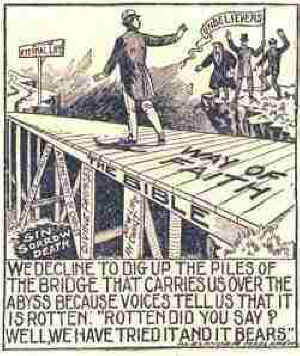
XIII- THE SURE WORD OF GOD"LET intellectual and spiritual culture progress, and the human mind expand as much as it will; beyond the grandeur and the moral elevation of Christianity, as it sparkles and shines in the Gospels, the human mind will not advance."- Goethe. As Hugh McIntosh so grandly says: "A tone of authority, an air of certainty, a breath of eternity, and a voice of God seems ever to pervade the book, and creeps around the reader's spirit like the speaking silence of the lonely mountains, and sinks down into the sympathetic soul as the voice of the eternal Father - like the deep and solemn tone of the ever sounding sea."-"Is Christ Infallible and the Bible True?" page 11. "Nothing is to be accepted save on the authority of Scripture, since greater is that authority than all the powers of the human mind."- Augustine. In previous chapters, we have examined many of the devious methods by which higher critics attempt to make it appear that the Bible is the word of man. Since the difficulties in the Bible are the foundation of and reason for higher criticism, I will endeavor to show that the difficulties, so far from constituting a basis for repudiating the Bible as the word of God, are among the best evidences in favor of the Bible as the divinely inspired book of God. The carping of the critics seems not so much for the purpose of arriving at the truth as to muddle others; not so much to lead others to the light as to impress them with the critics' brilliancy. Subtlety of argument, ingenious playing upon words, eager pursuit of startling paradoxes, seem to characterize this reckless search for difficulties in the Bible. They treat the Bible as the Jewish spies who dogged the steps of Jesus treated Him, "laying wait for Him, and seeking to catch something out of His mouth, that they might accuse Him." Luke 11:54. But they may profitably bear in, mind Christ's fearful denunciation: "Woe unto you, lawyers! for ye have taken away the key of knowledge: ye entered not in yourselves, and them that were entering in ye hindered." Luke 11:52. But how strange it is to see Christian men, in the effort to support vague theories, eagerly seeking argument where the most vitriolic foes of the faith have ever sought to find the weapons to vent their diabolic hatred in virulent attacks upon the word of God! How amazing to see Christian writers repolishing the old arguments of Paine and Celsus, drawn from discrepancies, and then illogically imagine that they establish the Christianity of the Bible! Yet such is their vaunted purpose, and such their argument to win to Christianity. This is as if an army defending a fortified town should think to accomplish this defense the better by abandoning the city and uniting with its enemies in their attack upon it and those who still defended it. Of course, there are difficulties in the Bible. But since when is the difficulty of comprehending a thing proof that it is false? Shall we, because we cannot comprehend fully the nature of electricity, conclude that to use electricity is folly, and disconnect our houses? Because no one has explained the phenomena of sight, shall we conclude that sight has no value, and put out our eyes? Because process by which our bodies assimilate food has never been understood, shall we refuse to eat? The Bible, however, recognizes its own difficulties, but adds a caution in regard to them, much needed at this time. Writing of Paul's epistles, Peter says they contain "some things hard to be understood, which the ignorant and unsteadfast wrest, as they do also the other Scriptures, unto their own destruction." 2 Peter 3:16. This clearly teaches that in all the Bible there are things hard to understand. When the infidel or the critic approaches us with difficulties, we need not be either surprised or alarmed; for the Bible says they are there, and to say they are not would be to deny the Bible. The only thing that concerns us is whether we wrest them to our destruction. If the words of the Bible are enshrined in the heart and shine out in the life, it will be a savor of life unto life; but if, on the other hand, it is wrested to support sin in the heart and iniquity in the life- if lies are dressed up as truth- it will be a savor of death unto death, and the brilliant light will turn into denser darkness. Now, the difficulties of the Bible are of two kinds, those made by man and those inherent in the subject. Those made by man may be removed by man. They consist of wrong interpretations and false inferences which are charged to the Bible as Scriptural teaching and then made the grounds for repudiating the Bible. This is the infidelic and critical favorite method of procedure. Other difficulties arise because the language in which the Book was written is disused. Many of the expressions, images, and thoughts are of countries, ages, and persons entirely different from anything we see. The manners and customs it describes have largely passed away. Its history covers thousands of years, and the greater part of the earth's surface. Its precepts refer to both worlds, and are necessarily expressed in terms of only one. And the whole is comprised in one brief volume. Keeping these facts in mind, it is evident that there must be difficulties of many and various kinds. Much is made of the historical difficulties and supposed contradictions between the Bible and other authentic records. But the whole tendency of recent investigation, historical and archaeological, is beyond doubt to establish not only the historicity and authenticity, but in many cases even the minute accuracy, of the Bible record. This is shown by the vast and accumulating mass of literature by the foremost experts and highest authorities upon the testimony of the monuments, tablets, resurrected cities, mounds, libraries, and other records of ancient Egypt, Babylonia and Assyria, Syria, Palestine, Sinai, as well as the immense amount of corroborative evidense from Asia Minor, Greece, Rome, etc., together with the testimony from the literature, lands, and usages of the peoples of the East who were in touch with the people of Israel. These discoveries have exploded many of the most confidently assumed critical theories, and shown the baselessness of the bold assumptions upon which the critics build their imposing structures of cavil, and have disproved many of their finespun philological theories. Since this recent knowledge has removed many once formidable objections, it establishes the principle of vanishing difficulties, and makes possible, if not probable, the complete removal of all such difficulties with greater research and completer knowledge. The alleged discords between the Bible and science have arisen mainly from overlooking the fact that the Bible is a popular book, written not in scientific terminology, but in the language of the people. For instance, the same skeptical scientist who ridicules the Bible for unscientifically speaking of the sun as "rising" and "setting," invariably uses the same words when he comes to describe the same event. His objection to the Bible, in such a case is a mere subterfuge, and should not deceive the simplest. Concerning the common belief that science and Christianity are and have been engaged in a life-and-death combat, it is a fact that nearly all the great discoverers and pioneers in science have been devout men, such as Newton, Cuvier, Faraday, Herschel, Galileo, and scores of others. It is by telling the people that all scientists are with them that the new theologists would quarantine the people - to keep them immune from the bacillus of belief in the Bible. As to the famous differences between the records of Genesis concerning the formation of the earth and the evolutionary doctrines of geology, botany, and zoology, it is only necessary to say that the difficulties have been created by the evolutionists' gigantic assumptions of absolutely unproved theories. The whole situation simmers down to this: Shall the baseless hypotheses of skeptics be accepted instead of God's facts? The discoveries of science are corroborating the Bible statements in a most wonderful manner. Difficulties that have existed for thousands of years are now vanishing before the light of modern research, and here also the principle of vanishing difficulties is established. The solution of these difficulties has been gradual, and for the best of reasons. Each age has had its own difficulties to face, and has faced them with its own peculiar evidence. The gradual solution of these difficulties has supplied each age with fresh evidence of the truthfulness and trustworthiness of the Bible, and excited continued and increasing interest in it. Thus God has used the puzzling things in the Bible to incite to its study and lead to new truths. The fact that the sins and immoralities of the peoples, and even of the chosen people and their leaders, are laid bare, has been a stumblingblock in the way of many who are accustomed to the modern panegyrics called biographies. But, as Dr. Barrows says "It faces things as they are in a world gone wrong; and as the scenes in human life are not arranged with the elegant luxury of a French salon, where every object attracts and pleases the sensitive and critical eye, so the Bible, the Book of life, is not the dilettante's book. . . . It aims not to flatter the drawing-room fastidiousness which cares for words rather than for things, and is more shocked by a breach of conventional etiquette than by the breaking of the statutes of Mount Sinai."-"Christianity the World Religion," pages 182, 183. Thus what is advanced as a poser against it is one of its strongest claims to credence. It condemns sinful man in all his ways, calls him a shadow, as grass that withers, as smoke that blows away, fallen, depraved, desperately wicked, his intellect darkened, his righteousness but filthy rags. All the nations of the world are represented as nothing, as less than nothing; and it exalts God alone, as ruler of the universe and man, and points the only road to salvation and true greatness. Mankind, however, is so enamored of "self-government" that it would fain silence this one troublesome Book that so insistently sounds its unwelcome claims of sovereignty in the unwilling ears of rebellious humanity. Higher criticism has come to the aid of those who would be free from what Dr. Gordon calls "bondage to a Book," and in pulpit and pew, is prating of "religious free thought," and pointing to the mountains of stumblingblocks they have found in the Bible, as evidence of their "Christian liberty." Since the Bible will not be silenced, since it still proclaims man as fallen and sinful, waxing "worse and worse, deceiving, and being deceived" (2 Tim. 3: 13), in desperate need of a Saviour, and since critics and infidels claim to be risen, to be their own gods, modern ministers now cut the knot of the perplexity by saying boldly, "Never mind what the Bible says." Away with the old Book anyway! We will not have this Book to rule over us. But if critics and skeptics set such store by dilemmas, let them face the overwhelming objections and attempt to remove the monster difficulties of their own theories, and the principle that leads them to repudiate the Bible will equally compel them to abandon their own theories. Besides the kinds of objections mentioned above, there are difficulties as to inspiration, prayer, miracles, the incarnation and resurrection of Christ; difficulties relating to the Trinity, the atonement, the love of God in the midst of pain, and much else, all of which is universally discussed in the pew and from the pulpit, and eagerly repeated by popular journals, echoed by unthinking readers, treasured by skeptics, and repeated by critics upon every occasion. Such difficulties as attend, for instance, belief in the atonement of Christ are such as are inherent in the doctrine; and no amount of reasoning or research will ever avail to remove them, any more than it could ever be possible to pour the Pacific Ocean into a pint cup. The atonement is infinite in its meaning; and for the finite to comprehend the infinite so that no difficulty shall exist is patently impossible. Hence the presence of perplexities concerning these doctrines stands as a bulwark of proof that the Bible is the word of God. If anything purporting to be of divine origin contained no mysteries, we might then wonder, and be disposed to question if such a revelation could possibly be from the infinite God. The very difficulties of the Bible show its divinity; and the absence of mystery would be the greatest difficulty of all, and the basis of more plausible objections than can be made from its mysteries now. To expect the solution of every perplexity were foolish. "The last step of reason," says Pascal, "is to know that there is an infinitude of things which surpass it." As we contemplate the Bible's many and great "mysteries of godliness," we are led to exclaim with Paul: "0 the depth of the riches both of the wisdom and knowledge of God; how unsearchable are His judgments, and His ways past finding out!" If we were to wait till every difficulty is removed before believing, we should believe very little of anything. Even the primal truth of science, the law of gravitation, is not free from grave difficulties; and the primal truth of the Bible, that God is love, is not free from the difficulties caused by the prevalence of suffering. But these difficulties do not prevent us from believing in gravitation, nor in God. It would be well in this connection to remember the words of an eminent scholar who spent all his life considering the difficulties of Scripture. Says Dr. Westcott: "Even in those passages which present greatest difficulties, there are traces of unrecorded facts which, if fully known, would probably explain the whole. And besides all this, there are so many tokens of unrecorded facts in the brief summaries which are preserved, that no argument can be based upon apparent discrepancies, sufficient to prove the existence of absolute error."-"Introduction to the Study of the Gospels," pages 380, 400. The difficulties of the Bible, in the purpose of God, serve high ends for the good of man. They tax our minds, and reveal our ignorance. They teach us humility, and train us in patience. They try our faith, and in its trial strengthen it. They lead us to a simpler dependence upon God, and thus increase our spirituality. Because of its difficulties, the Bible has exhaustless fullness, perennial freshness, everlasting newness, infinite depth. Every Christian finds in it something that no other has found. Every age finds it adequate to its varied demands, and every nation finds it stored with treasures suited to its peculiar needs. Thus have the passing ages, with their blasting criticism, and rigid tests, served only to disclose its accumulating riches; and still the mine of truth seems to be as filled with precious metal as ever, awaiting the eager search of the honest and earnest investigator. Besides all of this, is the evidence of the Christian who has answered the call to "taste and see that the Lord is good." The most prevalent evidence of the divinity of the Bible is the fruit of its teaching when received in the heart and worked out in the life. Scores of thousands the world over are living testimony to the divinity of the Word; and even the hypocrites who parade in the name of Christ are but further proof of the truth of the Bible, for their existence was foretold. At once the greatest difficulty in the Bible and the weightiest proof of its divinity is Jesus Christ. He stands out commandingly among all the sons of men, unapproached and unapproachable. He walks down the ages with the tread of a conqueror, while around Him shines a lonely moral splendor that has compelled even skepticism to bow the head in hushed reverence. Yes, even the vitriolic pen of Tom Paine paused to praise Him. Upon the impregnable Rock of Ages, all criticisms are baffled, broken, and shivered. Christ is the great spiritual magnet drawing all men to Himself. From heaven, with the accumulated love of eternity in His heart, came this King of kings, to be one with humanity, to suffer the vilest mockery, endure the strongest temptations, and experience the lowest of deaths, that you and I might know what love is, that we might be reconciled to God, be restored to Edenic innocence and happiness. Around Him, all truth clusters and revolves, as do the planets about the sun. Roman greed and Jewish hate and Greek subtlety united to stamp out the truths given by Him. Such a powerful combination has no parallel in history. But the banner of the cross has been unfurled in far-off regions where even "the wings of the Roman eagle" never flew, and where the fame of the sons of fortune never sounded. Babylonia, Persia, Greece, and Rome, those mighty empires which bore such arrogant sway upon the earth where are they? Their glory is dimmed and their power departed forever. The dust of centuries, the blood of millions, lie upon their well-nigh forgotten ruins. But the glory and power of the lowly Galilean, who spoke as never man spoke, is gathering beauty and momentum with every attack, with every age. And His word, as He foretold, is going rapidly to every nation, tongue, and people; and wherever the Bible goes, civilization, morals, and light arise. But the devout Christian need not be alarmed by the boastings of criticism. All he needs remember is that "Thy word is truth," and that no matter what the claims of this new "science falsely so called," nor how much like "an angel of light" its advocates, "the Scripture cannot be broken." Finally, in the words of Hugh McIntosh: "And so will progress in the knowledge and experience of its infinite depths of grace and truth go on, as, through the night of doubt and sorrow, the church of the living God is led by the providence of God, and the teaching of the Spirit of God, into the meaning of the word of God, till the day dawn, and the day-star arise in our hearts, amid the full blaze of the light of the knowledge of the glory of God in the face of Jesus Christ in all the glory of His appearing. Then, and not till then, will the written Word vanish in the light of the eternal Word as fades the morning star into the glory of the noonday sun."
|