|
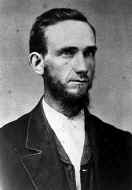
D. M. CanrightTHE MAN WHO BOARDED THE PHANTOM SHIPPart 3 After a few months of preaching, he again lapsed into doubt and darkness. A year after he wrote "Danger of Giving Way to Discouragement and Doubts," quoted from, above, he gave up preaching and went to farming in Otsego, Michigan. In a letter to an acquaintance he said that he was busy with farming work and never intended to return to ministerial work. Through it all, Ellen White had been one of his best friends. Especially during his lapses, for she it was that would write pleading letters in which she would clearly state the problems he was facing and point out to him the path he must take in order to again have peace with God. But the letters rankled in his heart. We do not always appreciate those who come the closest in seeking to help us. In a letter dated December 8, 1883, he spoke of high regard for "Elder Butler and all the other leading men . .I have no feelings against any of them, excepting Mrs. White. I dislike her very much indeed . . But they are good men for all that, and I never shall willingly oppose them. I am a member of the church still and do all I can to help it. But if I were situated differently, I would just as soon join some other church."—D.M. Canright, Letter dated December 8, 1883. Elder Butler, Canright’s long-time friend, later wrote about this latest lapse of Canright: ‘So notorious was his apostasy at the time, that without doubt the church stood where a little encouragement would have led them to withdraw the hand of fellowship from him. But some of us who felt a pity for him, knowing his weakness, counseled delay, and commenced to labor earnestly to help him. "—G. I. Butler, in "Review Extra," December, 1887. But his friends would not give him up. Pleading with him, they urged him to come to a campmeeting at Jackson, Michigan. Arriving at this September, 1884, gathering, the clouds of darkness seemed to dispel as he gathered with the Advent believers once again. After much prayer and counseling with brethren, he had opportunity to get the personality conflicts, that he had imagined to exist between him and others, resolved. Then, publicly, he took his stand with Seventh-day Adventists, and approximately a thousand people, many with tears in their eyes heard his tearful confession of uncalled-for bitterness and discouragement. He spoke of the clouds of darkness that had swirled through his mind, and said that now all that was past. He again stood in the light. He told of how for years he had felt bitter feelings toward Ellen White, and he said it was because of the personal testimonies she had sent him pleading with him to put away his sins. With a few of the brethren, he then went to Sister White, told her of it and asked her forgiveness. She later wrote about this experience: "You then humbled your heart, and upon your knees asked me to forgive you for the things you had said about me and my work. I freely forgave you, and it was not against me. None of these things were against me; I was only a servant bearing the message God gave me."—5 Testimonies, page 623. Back to work he went, holding public meetings, seeking to win souls for Christ. And he wrote up a fuller explanation of the "bitterness against the testimonies "problem. In the "Review "he told that the difficulty went back some eleven years to the time when he and Lucretia had received a testimony from Ellen White that told him of improvements he needed to make for his own safety. (You may read the letter for yourself. It is printed, without, of course, mentioning his name, in 3 Testimonies, pages 304-329, under the title "To a Young Minister and His Wife." We have earlier spoken of that Colorado visit that took place in 1873.) Then, in the "Review" article he mentioned the testimony he received in 1879 (the year, incidentally, when he was to begin elocution studies in Chicago). He told of how, in his heart, he had rejected both testimonies. But with the help of Elder Butler, he re-examined those testimonies and saw that he had "put a wrong meaning on some things, and that other things were certainly true." "For the first time in years I could truly say that I believed the testimonies. All my hard feelings toward Sister White vanished in a moment, and I felt a tender love towards her. Everything looked different." "I think that my disbelief of the testimonies and other truths has come by opening my heart to doubts, cherishing them and magnifying them . . Like Peter, I did not know myself till God left me to be tried. I feel greatly humbled under the shameful failure I have made . . Friday, Sept. 26, while on the campground at Jackson, Mich., I felt in my heart the most remarkable change that I ever experienced in all my life. It was a complete reversion of all my feelings. Light and faith came into my soul, and I felt that God had given me another heart. I never felt such a change before, not even when first converted, nor when I embraced this message, nor at any other time. I want to say to all my friends everywhere, that now I not only accept, but believe the testimonies to be from God. Knowing the opposition I have felt to them, this change in my feelings is more amazing to myself than it can be to others "I am fully satisfied that my own salvation and my usefulness in saving others depends upon my being connected with this people and this work "—D.M. Canright, in "Review," October 7, 1884. Personal sin, the pride of life, and resentment against the re-proofs to repent and change one’s life—lay at the heart of the Canright problem. And this is the problem that many since his day have had also. A young Adventist stenographic secretary in one of the Battle Creek institutions was present that weekend at the Jackson campmeeting. His name was W.A. Spicer. He was later to become a General Conference President. Spicer said that he heard Canright read a testimony from Ellen White that he said he had rejected eleven years before: "‘I did not believe it when I read it eleven years ago,’ he told us, holding it up before the congregation. ‘But I have lived to see every word of it fulfilled.’ He [Canright] came back into the work. But for me that campmeeting brought a coming ‘into the work’ also . . At the Jackson meeting somebody’s preaching sent the conviction into my heart that going only halfway into this thing meant losing eternal life. I surrendered anew to Christ and this message. Then everything was new to me. I went back to the headquarters ‘in the work.’ I was in this movement heart and mind and soul and all. "—W.A. Spicer, in "Review," November 17, 1949. A General Conference Session was held the first three weeks in November, 1884, and Canright attended it. Area meetings were held, just following it, in Otsego, Michigan. Ellen White wrote of her response to see Elder Canright up in front, speaking to the people again: "How my heart rejoiced to see Bro. Canright all interest, heart and soul in the work, as he used to be years in the past! I could but exclaim, What hath the Lord wrought!"—Ellen White, in "Review," December 2, 1884. Having spoken at the Saturday night meeting, he then presented the Sunday morning meeting, at which he spoke of his current feelings about the unchangeable truths: ‘It seems to me. . that my whole soul is now bound up in this present truth. I have tried to analyze my feelings, and I have reached some conclusions. Sometimes an individual gets started on a wrong train of reasoning, and he sees it when he’s far away. Then he finds it hard to get back again. This was my case, exactly . . I went to farming . . [Some] may say, Why did you not do right? I am satisfied that man’s wisdom is not always reliable. He must have the Spirit of God to guide him, or he will go wrong. Now I want to say that I have been changed right around in my feelings and convictions.. "There is a point that has bothered me a little, and I want to speak of it. In the twenty-five years I have been with our people, I have traveled from Maine to California, and I have never known one man who has drawn back and begun to harbor doubts who did not begin to separate from God. I have never known one who through such a course has become more spiritual or more anxious to do something to save his fellow-men. I have never known one man to do that, and I do not believe I ever shall. When I left off preaching, I vowed to myself and to my God, that I would go right along laboring as I had done, be faithful in the church, and do my duty every time. Well, brethren, after I had gone that way for a time, I found that I had lost my hold upon God. I lost my spirituality. Now there must be something wrong about such a course, for if it is right it seems to me that a man would certainly prosper in that way.. "Brethren, I will say this: So far as I am concerned, I will start right here,- and all that I have, all that I am, I will put into this work, and take my risk of everything. I will never do this backing up any more; and I believe that if I ever go back from this I am lost. All I have I will give to this cause. I believe there is in this truth that which will save men. I have seen drunkards saved by it, and the wickedest of men saved by it, and may God help us to triumph with it when Jesus comes."—D.M. Canright, Sermon at Otsego, Michigan, November 23, 1884, quoted in "Review," December 2, 1884. Ellen White was deeply happy that Canright was back in the work, preaching and helping the people. During those Thursday to Sunday meetings at Otsego, she stayed at his home. Later she wrote of it: "We were continually grateful to God that we felt indeed at home, and that Bro. Canright had met with so great a change in his feelings . . I felt that peace rested in the plain but comfortable home of Bro. and Sr. Canright. I could but make melody to God in my heart every moment as I considered the work that had been wrought so wonderfully in this case. Eld. Canright saved to the cause! His precious family led into the ways of truth and righteousness!"—Ellen White, in "Review," December 2, 1884. Back into the field went Elders Butler and Canright. Evangelistic meetings were held in Pennsylvania, Minnesota and Iowa. Joy and renewed faith in the work he must do with the angels in bringing souls to Christ animated his face and his reports in the "Review." At the heart of it was confidence in the Spirit of Prophecy. Speaking of the blessing that reading those writings had again brought to him, he wrote in the January 6, 1885 issue: "If the Spirit of God does not speak to us in these writings, then I should despair of ever discerning it." That winter his fourteen-month-old son, George, died. In response, he wrote Ellen White, wondering why God could allow such a thing, and whether it were possible that the child might someday be in heaven. He concluded with trust that somehow God might overrule in the matter. Between March 15 and June 14, 1884, Canright had written ten provocative articles for the "Review" in defense of historic Adventism and the Spirit of Prophecy. And now, in 1885, he again wrote another powerful one on the same topic. This one, published in the February 10, 1885 issue, and entitled "To Those in Doubting Castle" was a powerful defense of present truth and God’s last-day messenger. In view of the savage attacks that, within two years, he was to spew out both in lectures and in print, it is well worth reading these eleven articles. To the degree that we have room we will include excerpts from them within boxes elsewhere in this present historical study. As we proceed we shall find that a dark spirit took control of D.M. Canright. He knew the truth and knew that it was the truth. But he turned from it with the hope in mind of obtaining praise from a larger audience. The result is one of the most startling Jekyll-and-Hyde personalities that this writer has ever come across. But it carries a lesson—a solemn lesson— for each one of us. Any man having learned this precious message, given us by Heaven, who then turns upon it—and fights it, is in serious danger of a demon possession that he may never escape from. May God have mercy on us all. Better were it that such a one were never born. Fellow believer in the Advent Message: You have Canright’s experience before you. Consider it carefully, lest personal sin or unwise associates lead you into his track. That summer he wrote a note to Ellen White, expressing his firmness in the faith: "As for myself, the old difficulties which I had, as you know, have been removed. I think I see now clearer and better than ever I did before. There was always something that bothered me because I did not have right understanding of it. I feel as though my faith and confidence are stronger and on a more solid basis than ever before. I think that the evidence is rapidly increasing that this is the Lord’s special work. I have no other thought but to give every energy of my life to it. I pray God will bless you, and give you strength to do the work you are so much needed to do. It would be worth a good deal to us if you could be here a few days now. It may be that you can come here yet this summer. Your brother in the faith, (Signed) D.M. Canright. (Letter, dated June 23. 1885.) Near the end of July, as she was in transit to Europe, Ellen White stopped at Canright’s home for several days. Learning that she was coming, he arranged a number of speaking appointments for her. After her departure to Europe, he wrote appreciatively of her visit. She spent the full year 1886 in Switzerland, where a number of letters arrived from Canright. "I never felt better physically. Can work hard all the time and feel well, too. My courage is good and I love the work." (Letter to Ellen White, dated February 17, 1886.) The last three weeks of Uriah Smith’s Spring Semester, 1885, Bible classes at Battle Creek College, were concluded by Canright. Smith’s health was failing and D.M. offered to finish up the year for him. That fall, he also taught the first five weeks of Smith’s Fall Semester classes, as well. Canright was later to use this as the basis for his claim that he was a veteran Bible teacher at the Adventist college in Battle Creek. During his work with the denomination, he had prepared eleven Sabbath School lessons, two books ("The Bible From Heaven," based on a book by Moses Hull, and "The Doctrine of the Immortality of the Soul," which he wrote himself), four pamphlets and fifteen tracts. By now it was Fall, 1886, and the final turning point in Dudley’s life. Satan would lead him to burn enough bridges this time that he never afterward felt that he could return to the Church and the people and the message that he loved to his death. D.M. Canright was talented and highly regarded by workers and laymen. But he could not be crossed. The appreciation must be unceasing or he felt he had been wrongly treated. G. I. Butler knew Canright better than many others. Here is his comment: "When everything went pleasantly, he could usually see things with clearness. When he was ‘abused,’ as he always thought he was when things did not go to suit him, the evidences of our faith began immediately to grow dim. Dark clouds of unbelief floated over his mental sky, and he felt that everything was going by the board. Here was the Elder’s special weakness. He is a strong man in certain directions when all goes smoothly, but very weak in adversity. He failed to ‘endure hardness as a good soldier of Jesus Christ.’ He was good in a fight, and appeared at best advantage when in a hot debate. This was his forte. But when things apparently were against him, he seemed to have no staying, recuperative qualities.. His desire to have his own way sometimes got him into trouble. He never could bear reproof with patience, or feel composed when his way was crossed. When he came to mingle in important matters with brethren in prominent positions, these and other traits naturally got him into trouble. "—G. I. Butler, in "Review Extra," December, 1887. These traits, easily observable by those who worked closely with him, caused them to hesitate to place him in positions of responsibility when choices were made for conference and General Conference leadership. Elder E. R. Potter was a minister for many years in the Michigan Conference. It appears that the following statement provided by him reveals the event that marked the final turning point in the life of Dudley Mervin Canright. He left the Church, God, and eternal life—over an election: "About the year 1918 a cousin of Eld. D. M. Canright came to our home and spent a few days. I asked this cousin what he knew about D. M. Canright. He replied "I will tell you one thing. Just before he left the denomination, Eld. Canright came to the [1886] Mich. campmeeting with his team and I took care of his horses. On that occasion my cousin said, ‘If I am not elected President of this Conference at this meeting, I am not going to preach for them any more.’ "—Statement Concerning D.M. Canright, by Ray Birmingham, Alma, Michigan, September 7, 1947. At that fateful campmeeting, George I. Butler, not D.M. Canright. was elected to the presidency of the Michigan Conference. Such powerful events, and even destinies, can be hinged to such little matters. There is a striking passage on page 571-572 of Volume 5 of the Testimonies. You, no doubt, are well acquainted with it. What you may not know is that it was written to D.M. Canright. The entire passage can be read on pages 571-573. It was penned in the late 1880’s, and very possibly in the late fall of 1886: "Dear Brother M [Canright]: I had an impressive dream last night. I thought that you were on a strong vessel, sailing on very rough waters. Sometimes the waves beat over the top, and you were drenched with water. You said: ‘I shall get off; this vessel is going down.’ ‘No,’ said one who appeared to be captain, ‘this vessel sails into the harbor. She will never go down.’ "But you answered: ‘I shall be washed overboard. As I am neither captain nor mate, who cares? [Which would summarize his thoughts at the time.] I shall take my chances on that vessel you see yonder.’ "Said the captain: ‘I shall not let you go there, for I know that vessel will strike the rocks before she reaches the harbor.’ "You straightened yourself up, and said with great positiveness: ‘This vessel will become a wreck; I can see it just as plain as can be.’ "The captain looked upon you with piercing eye, and said firmly. ‘I shall not permit you to lose your life by taking that boat. The timbers of her framework are worm-eaten, and she is a deceptive craft. If you had more knowledge you could discern between the spurious and the genuine, the holy and that appointed to utter ruin.’ "I awoke, but it is this dream that leads me to write to you. I was feeling deeply over some of these things when a letter came, saying that you were ‘under great temptation and trial.’ What is it, Brother Canright? Is Satan tempting you again? Is God permitting you to be brought to the same place where you have failed before? Will you now let unbelief take possession of your soul? Will you fail every time, as did the children of Israel? God help you to resist the devil and to come forth stronger from every trial of your faith! "Be careful how you move. Make straight paths for your feet. Close the door to unbelief and make God your strength. If perplexed, hold still; make no move in the dark. I am deeply concerned for your soul. This may be the last trial that God will grant you. Advance not one step in the downward road to perdition. Wait, and God will help you. Be patient, and the clear light will appear. If you yield to impressions you will lose your soul, and the soul is of great value with God." —5 Testimonies, page 571. How valuable the counsels of God can be in the moment of great perplexity and trial. Oh, that we may value those counsels always! But Canright did not do so. He chose to board that phantom craft out in the dark waters. In January of 1887, Canright informed his old friend, George I. Butler, President of the Michigan Conference that he was leaving. In a letter to the General Conference he said that he could be a Seventh-day Adventist no longer. On the evening of February 17, 1887, at a business meeting of the Otsego Seventh-day Adventist Church, Dudley Canright poured out reason after reason why he was forsaking the ship. In view of the whole story, before and after, of this man, the present writer questions whether Canright really believed the things he said that night. To this, his home church, he cut the connection as best as he could. Here is the church clerk’s record: "That he had come to a point where he no longer believed that the Ten Commandments were binding upon Christians and had given up the Law, the Sabbath, the Messages, the Sanctuary, our position upon [the] U.S. in prophecy, the Testimonies, health reform, the ordinances of humility. He also said that he did not believe that the Papacy had changed the Sabbath. And though he did not directly state it, his language intimated that he would probably keep Sunday. "He thinks that Seventh-day Adventists are too narrow in their ideas, and that in quoting so much as they do from the Old Testament are going back into the moonlight rather than experiencing the sunlight of the gospel of Christ. He thought we were exalting the law above Christ. Also has no faith in the missionary work as conducted by our people, feels as if it is not the way God designed to do the work. "He still claimed to believe that the coming of Christ was near, making the same application of Daniel 2 and 7 and Matthew 24 that he always had, but did not believe that there was to be any special message preceding Christ’s second coming in the sense in which Seventh-day Adventists teach."—Church clerk’s record, February 17, 1887, Otsego, Michigan SDA Church. Friends knew that his wife, Lucy, would have been glad to remain in the Church, for she had many friends there. (Years later he admitted that she cried deeply when the break was made—Letter and obituary of his wife, submitted to the "Review" on May 5, 1913, and published in it on June 12, 1913.) But Lucy had always gone with him in his several trips into and out of the Church. That evening she said she pretty much agreed with his doctrinal ideas, and stood with him. So, at their request, both were dropped from the Church. In writing to Ellen White, who was still in Europe, he said, "Whether I have decided right or wrong the judgment must tell. Sister White, believe me when I say I wish you and our people well and hope that you may help to save some and reach eternal life with them . . My wife and family go with me." (D.M. Canright letter to Ellen White, dated March 18, 1887, written from Otsego.) Elder Butler, who attended the fateful meeting that night at the Otsego Church, wrote that Canright told him that he "expected to unite with the Methodists, Baptists, or some other evangelical denomination, and continue to labor in the ministry as long as he lived." ("Review Extra," December 1913.) But Lucy had always gone with him on his several trips to see which denomination to pick from. Finally he chose the Baptists, and on March 5, 1887, he, his wife and their daughter Veva (Genevieve) were accepted into the Otsego Baptist Church. On the 17th they gave him a license to preach, and then ordained him and made him their salaried pastor two days later. This arrangement continued for a year and a half, and his services were terminated. E.J. Waggoner, editor of the "Signs of the Times," published an account of what had happened to Canright’s pastoral work during those two years, in the Healdsburg, California, "Enterprise," of February 27, 1889. In that year and a half, "his congregation had come down from 200 to 25, and he was obliged to resign his pastorate, which he did some five or six months ago. There were only twenty-five present to hear his farewell sermon." In addition, he mentions that some of "the leading Baptist ministers" had become estranged from him during that time. "The feelings of these ministers [was] that Canright seemed so important and overbearing." "The policy of the Baptists is such that if a preacher can find a single [Baptist] society, or part of a society that will acknowledge him, he cannot be shaken off, although he may be despised by the great body of Baptists. It is often unfortunate for the Baptist’s denomination that such is the case, but so it is. Mr. Canright was wise in selecting that body when he left the Adventists." Late in September, 1890, Canright moved with his family to Grand Rapids, Michigan. There, the young Berean Baptist Church took him on as their pastor. He remained their pastor for a year and a half. Then, two years later, he was taken on again for another year. So, in October of 1896, he was dropped from the active ministry and never again was he able to obtain a church pastorate. Fortunately, the Berean Baptist Church gave him a paper stating that he was "pastor emeritus" of the Church. For much of the remainder of his life, the title that he used in his writings was, "Pastor Emeritus, Berean Baptist Church." During his two pastorates, Canright had represented his local church at regional Baptist conferences. There, both workers and leaders had opportunities to meet with him and size him up. So when his own churches dropped him, he had no calls elsewhere. He who wanted so much to move on up the ladder—was out entirely. He was through, and knew it. With the termination of his employment in October, he moved to South Bend, Indiana, and then to Toledo, Ohio, where he engaged in door-to-door religious book selling. In 1899, he returned to Grand Rapids. From 1897, onward, when he was in his prime, D.M. Canright had no employment other than the selling of books from door to door, and what income came in from the writing of books against Adventists. But, unfortunately, the book-writing business did not pay very well. And so much of the time, he and his wife Lucy would go out separately each morning with books and try to sell them from door to door, in an effort to keep food on the table. By the 1900s, the books that both were selling were Adventist books. When asked why, he would respond that they sold better than other books. In 1897 he and his family lived in Toledo, Ohio, and the following three years in Adrian and Kalamazoo, Michigan, and then back to South Bend. In 1900 Canright returned to Grand Rapids, not to pastor a church, but to care for a garden and orchard. In 1904 the Baptists let his ordination papers lapse. With sufficient urging, they renewed them in 1907. But at this point, let us return to the year 1887. As you will recall, he and his family left the Adventist Church on February 17 of that year. He then requested Elder Butler that he might speak once more to the Church through the pages of the "Review." In his article, he commented on his recent decision to leave it and then he said: "Personally I have not one word of fault to find either with the church where I live or with those with whom I have labored. I have been treated fairly, liberally, and tenderly. There is not one hard feeling between us as far as I know. It will always give me pleasure to regard our people and speak of them as an honest and devout people."—-D.M. Canright, in "Review," March 1, 1887. It was intriguing that in the years to come he would repeatedly speak of the Advent people as "our people." But within a few months Canright began writing articles for the religious press of America in which he would slander and attack the Advent Movement and its beliefs. With the exception that he charged less, he made himself available for lectures against Adventists and Mrs. White, much as Walter Rea is doing now. Canright’s fee was $2 a night. In August, one Michigan Adventist wrote him a few lines to help him see what he was doing. Here is part of the letter: "I must declare that your own arguments are as weak and forceless as you have met a hundred times.. What will not a man do for the honor that comes from man? Balaam was a prophet of God and doubtless felt well, as you say you do, with the wages of unrighteousness in his hand, and the emoluments that a king could bestow. But he perished on the field of battle, when arrayed against the people of God. . I choose rather to suffer affliction with the people of God. I am astonished, but not disheartened that you have joined the hue and cry against us. For you, and yours, whom I remember with tenderest feelings, I pray, as Jesus prayed on the cross." —D.H. Lamson of Armeda, Michigan, Letter to D.M. Canright, dated August 16, 1887. Only a year and a half after Canright had solemnly pledged that he would never pursue such a course, he arranged for handbills attacking Seventh-day Adventists to be printed and circulated both in the public press and at the September, 1887 Adventist campmeeting, held in Grand Rapids. He made a special point of directing his attack particularly against Ellen White, who spoke at that campmeeting. But Ellen White had earlier given him good advice. And it was dangerous to give Canright advice. "He never could bear reproof with patience, or feel composed when his way was crossed. . He always hated reproof, hence bore it like a fractious child." —G. I. Butler, in "Review," December, 1887. When Canright was a 33-year-old minister in the Church, he had been given the following good advice. Although it perfectly described his danger, yet such messages rankled in his heart for years thereafter: "Brother Canright, in your labors with others, you have been the man who was severe and overbearing. Where your gray-headed gospel father [James White] would be pitiful, discreet, and cautious, you have sometimes been provoking and insolent. It is your nature to be overbearing . . Rashness is natural to you. You need to restrain yourself. Unless you bridle and restrain your rash spirit, you will be hurried to make some move which will ruin your usefulness, forever . . You are either on the pinnacle, or down in the low slough of despond. An accidental circumstance will arouse you, and call out every power of your soul. For a season, you will be exhilarated, and come up upon the wave of excitement or popularity. You will excel yourself and astonish your friends. But you are in danger of spending your force, and hosing the exhilarating power which stimulated you to action, and sink down into despondency and discouragement. In these fitful efforts you lose more than you would gain by steady, earnest effort . . Consider me not an enemy because I tell you the truth. I long and pray that you may be found in your right mind sitting at the feet of Jesus and learning of Him. . I pray the Lord to help you to get rid of some of your lofty ideas of yourself and come down in meekness, feeling your nothingness without Christ. Then will He be unto you a very present help in time of need."—Ellen White, Letter 1, 1873, to D.M. Canright. Later, Ellen White was to write: "He has used every check put on him by myself as a cause to throw himself." (Letter 13, 1887.) And, in correspondence intended to save Dr. J. H. Kellogg from heading the same direction, G. I. Butler spoke of Canright’s experience in fighting the Testimonies, and what it led him to: "I dislike to see you, who have professed, time and again, to be a full believer in the ‘Testimonies,’ as strong as anybody, begin to reflect upon Sister White as you do occasionally of late. It reminds me too much of Snook and Brinkerhoff [Iowa ministers who started an offshoot there in 1865], Canright, et. al. That is always the way those things commence. They were ‘believers in the truth’ and all that, but ‘Sister White, Sister White’ and you know the result. "Over and over did I try to save Canright who was once a power to the cause, a lecturer, and a debater. He was one of those who could not endure hardship. When everything went hard, he would ‘fly off the track. ‘Four times I helped that poor man back into the light, but the fifth time he went. It is enough to look into his face again and see what kind of a wreck he is left. He could do great things when God was with him, and the Spirit was with him, but after he moved out, the Spirit did not go with him; he was left to his own spirit and that of another power, and that has been the trouble with all those who go away from the body. G. I. Butler, Letter to J. H. Kellogg, dated May 10, 1904. Over the first several years, Canright was asked to travel to several places to speak against Adventists. But before long, his bitterness—and surprising reversals that he would make in public—lost for him his audiences, and requests for lectures ceased. In the year 1889 Canright brought out his 413-page book, "Seventh-day Adventism Renounced." But many recognized the inconsistencies in it and the bitterness that it was grounded in. The book, "In Defense of the Faith," by William H. Branson, and "Answers to Objections" by F. D. Nichol, are probably two of the best replies to Canright’s book. ("In Defense of the Faith" was a reprint of "Reply to Canright," first published in 1933.) In 1915 Canright published "The Lord’s Day From Neither Catholics nor Pagans," which soon passed out of print. The arguments in it were so shallow that people were not much interested in the book. His last book was published in the year of his death, 1919, and was entitled "Life of Mrs. E. G. White." It exhibits the bitterness of a serpent ready to bite. "E. G. White and Her Critics," by F. D. Nichol, is among the best replies to the unfounded and inaccurate charges made in this book. As we mentioned earlier, D. M. Canright was dropped from pastoral work in the Baptist church by the year 1897, and because the royalty income from the sale of his books fell far short of meeting the needs of his family, he, and later his wife, tried to make up the difference by selling books from door to door. We do not know the exact date, but at some time in the first or second decade of this century, D. M. Canright came to the Ambs’ home in Otsego. Elder K. F. Ambs, later a minister in the work, wrote the following account years later while residing in Washington D.C. "One afternoon, while father and I were away at work, mother answered the door and admitted an elderly man who was selling a small book. When she looked at the title it read, ‘Gospel Primer,’ by J. E. White. "Surprised, she said, ‘This is a Seventh-day Adventist book, isn’t it?’ to which the old gentleman replied, ‘Yes, ma‘am it is., ‘And are you a Seventh-day Adventist?’ she asked. To this he replied. ‘Well, I was a Seventh-day Adventist.’ "Upon asking him his name he replied that his name was Canright. "‘Are you D. M. Canright?’ she asked. "‘Yes, sister, I’m D. M. Canright.’ ‘Are you that man who had so much light and who turned his back on it?’ mother asked. "His response was significant. Said he, ‘Yes, sister, I am that man, and how often have I sought to find my way back but have been unable to do so.’ "As he was leaving he shook mother’s hand saying, as tears filled his eyes, ‘Sister, you have the truth, hold fast to it, never let it go. It is the very truth.’"—Letter from K. F. Ambs to D.A. Delafield, dated December 4, 1964. Part 4 |